A Souvenir from Matsumoto for Edo: “Matsumoto Single-Stem Leeks”
Matsumoto Ippon Negi is a traditional vegetable from Matsumoto. When
cooked, it becomes sweet and tender, making it perfect for hot pot dishes and the like.

Traditional Cultivation Methods

Deep-rooted leeks are grown to be long and thick by hilling them with soil.
The farming process—from sowing to transplanting, hilling, and harvesting—is continuous, but it takes more than nine months from sowing to harvest. In addition,
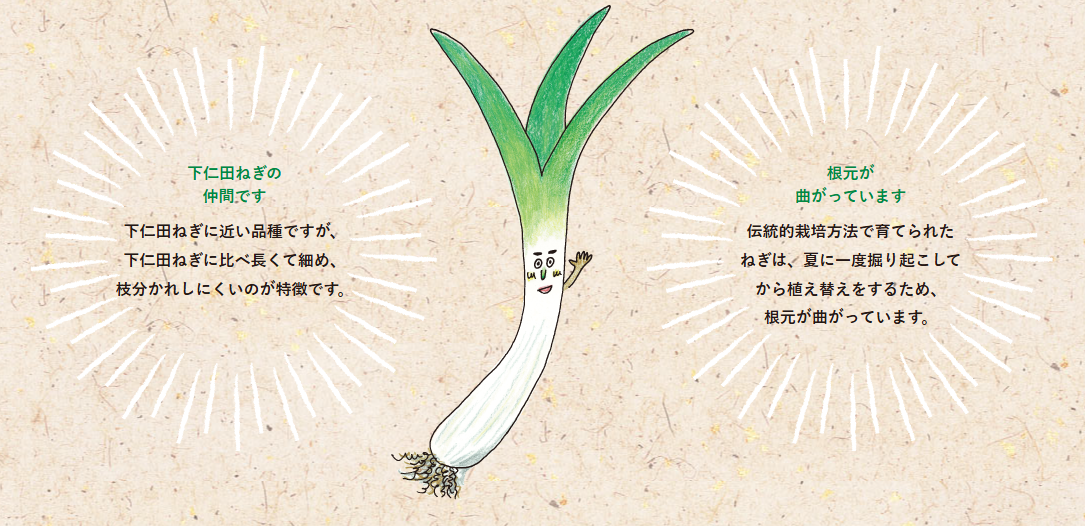
the cultivation of Matsumoto Single-Stem Leeks involves a process called “replanting.” This replanting, which is carried out during the hot season
, is a distinctive feature of Matsumoto Single-Stem Leeks.
Sowing Seeds
Sow the seeds between September and October. If you wait too long, the cold will kill the seedlings and they won’t grow.
Transplanting
The following spring, around the Golden Week holidays in May, when the weather warms up and the stems reach 6–7 mm in diameter, transplant the plants. This is also the time to purchase and plant scallion seedlings.
Hilling
About one month after transplanting, pile soil around the base of the plants. As they grow, continue to add soil around the base to encourage the growth of the white part. Repeating
this hilling process will increase the length of the white part.
Sometimes, onion flower heads may form; these are the flowers that produce seeds. Since you want to grow the onion bulbs, remove them as soon as they appear.
Replanting
Replant during the hot summer months. Dig up the fully grown scallions, create a new raised bed, lean the dug-up scallions against it, and mound soil around them. Replanting softens the fibers and lengthens the delicious white part.
Harvesting
Cut away one side of the mounded soil to dig up the leeks, then store them with the soil still attached to prevent them from drying out.
Storage
Methods vary by household, but one common practice is to dig a hole in the garden, line it with straw, and store the leeks there.
8 Recipes to Enjoy Matsumoto Whole Green Onions!
- Green Onion Fritters
- Chop the green onions and make a tempura fritter with them and your favorite vegetables.
- Scallion Pepperoncino
- Add olive oil to a frying pan, then add garlic, chili peppers, and green onions. Add the freshly cooked pasta and season with salt and pepper.
- Hamburger Steak with Green Onions
- Just use green onions instead of onions.
- Butter-Sautéed Green Onions
- Just add butter to a frying pan and sauté. Season with salt and pepper to taste.
- Grilled Green Onions
- Wrap the green onions in aluminum foil and place them on top of a wood-burning stove or heat them on a grill. Once they’re tender, they’re ready. They’re delicious eaten as is or with your favorite seasonings.
*It’s simple, and it’s the best way to enjoy the natural flavor of green onions. 
- Green Onion Milk Soup
- Place 5 to 6 green onions, cut into 6 cm pieces, along with enough water to cover them and a bouillon cube in a pot, and bring to a boil over medium heat.
Once it comes to a boil, add 1 cup of milk or heavy cream and simmer over low heat. Season with salt and pepper to taste. When the green onions become tender and soft, it’s ready.
*Eat the green onions along with the soup. Be careful—the hot center of the green onions may shoot out suddenly. 
- Green Onion Miso
- Coarsely chop 5 to 6 green onions. Lightly sauté the green onions in a little vegetable oil.
Add miso, sugar, and sake (or mirin if you prefer a sweeter taste) to your liking, and simmer.
Once the miso starts to bubble gently and becomes thick and syrupy, it’s ready.
*Note: The miso will harden as it cools, so turn off the heat when it reaches your desired consistency.
*Note: This goes well with rice.
You can use it as a filling for rice balls or spread it on grilled rice balls. 
- Sautéed Green Onions and Squid
- Chop the green onions into chunks and cut the squid into bite-sized pieces. Heat a frying pan, add minced garlic, and sauté until fragrant, if desired.
Add the squid and green onions. Once cooked through, season with noodle sauce, and it’s ready to serve.
You can use other seafood instead of squid.
*Matsumoto green onions go well with just about anything. 
Species Conservation Efforts
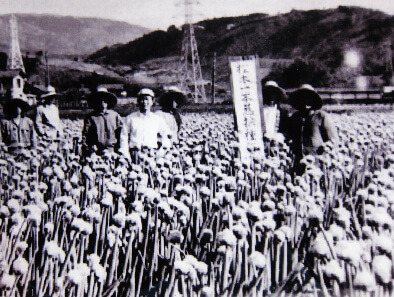
The JA Matsumoto City Green Onion Committee has preserved the traditional cultivation methods for the delicious Matsumoto Ippon Negi and received certification as a traditional Shinshu vegetable. They market it under the affectionate nickname “Magari-chan.” They are also particular about the seeds
, using only those harvested by the “Matsumoto Ippon Negi Seed Collection Association” (originally named the “Matsumoto Negi Seed Collection Association” when it was established in Taisho 8). Green onions are pollinated by bees and other insects that carry pollen.In the past, almost all green onions grown on the Matsumoto Plain were Matsumoto Ippon Negi. However, with the cultivation of many different varieties today, there was a risk that, if left unchecked, the Matsumoto Ippon Negi seeds would become hybridized, altering their original characteristics. Since Heisei 21, the Matsumoto City Agricultural Cooperative, the Faculty of Agriculture at Shinshu University, the Matsumoto City Agricultural Policy Division, and a local seed company have been collaborating on a breeding program to restore the variety to its original form.
Seeds are sown and seedlings are raised; based on their growth, those exhibiting the strongest characteristics of the Matsumoto Ippon Negi are selected from the field and replanted in a separate field. Pollination takes place in May of the following year, and seeds are harvested from mid- to late June. These seeds are then sown again from late September to early October, and the process is repeated to bring the variety closer to the original strain.This is such a meticulous process that if neighbors are growing other varieties of leeks, the growers must ask them to cut their plants at the “negi-bouzu” stage—before flowering—to avoid interference. I
believe the black-and-white photograph was taken in the Showa 20s. (Photo courtesy of Mr. Hideo Aoki, Chairman of the Matsumoto Ippon Negi Seed Production Association)
Are “Matsumoto Single-Stem Leeks” supposed to be curved?
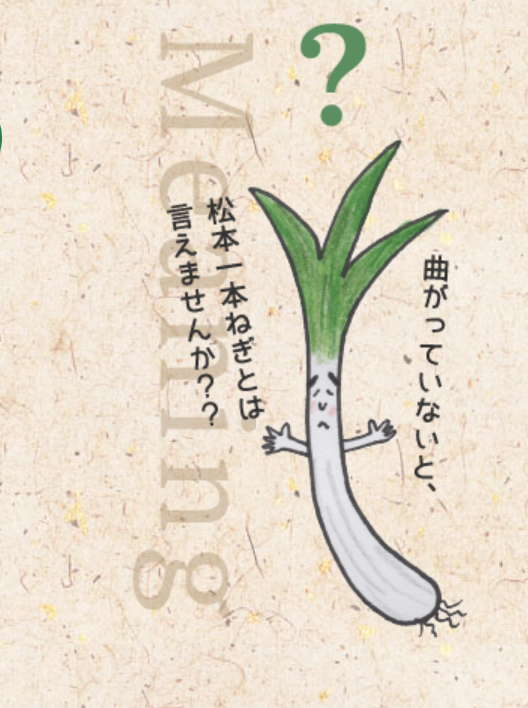
At farmers’ markets and other retail outlets, you can find both curved and straight “Matsumoto Ippon Negi,” even
though the name “Matsumoto Ippon Negi” refers to a specific variety.
So why is there this difference? The
answer apparently lies in whether or not the onions are transplanted.
In traditional cultivation methods, transplanting during the summer puts stress on the leeks, causing them to grow into sweeter, softer, and curved “Matsumoto Ippon Negi.” Because this process is labor-intensive, many producers choose not to do it, which is why you can also find straight “Matsumoto Ippon Negi” on store shelves.
The city of Matsumoto recommends growing “Matsumoto Ippon Negi” from commercially available seeds or seedlings and performing the transplanting process.The curved “Matsumoto Ippon Negi” grown using traditional methods has been certified by the prefecture as a “Traditional Vegetable of Shinshu,” and to increase its production, the city is implementing a “Crop Expansion Incentive Program.” Since the “Matsumoto Ippon Negi” was featured on a popular TV show, demand has outstripped supply, but thanks to these efforts, the cultivation area is reportedly increasing year by year. We hope that many people will have the chance to savor the tender, sweet flavor of the “Matsumoto Ippon Negi” grown using traditional methods
.
The History of Matsumoto Single-Stem Leeks
Matsumoto single-stem leeks were already being cultivated during the Edo period. It seems they were often taken as souvenirs—a Matsumoto specialty—when people traveled to Edo.
The *Mikawa Kofudoki* records the following story:
“Aritsuka, an ancestor of the Tokugawa family, ended up in Shinano Province with his son after a long period of wandering. There, they met Hayashi Tonosuke, the third son of the Ogasawara clan, who had returned to his hometown after falling out of favor in Kamakura.
When Arichika and his son sought him out, Tonosuke went out into the snowy fields, shot a rabbit, and treated them to a rabbit clear soup.
From then on, this became a auspicious tradition, and it is said that the shogun’s household adopted the custom of serving rabbit meat soup with zoni on New Year’s Day every year. The Matsumoto single-stem leek was used alongside the rabbit soup at that time.
It is said that Ochi Etsujin, a haikai poet of the Edo period, composed a poem about the celebrations at Edo Castle, alluding to the legend of “Rabbit Clear Soup” passed down in the Tokugawa family, writing, “Even in the reign of Yasuke, rabbit clear soup.”
(Reference: “Tales of Spicy Daikon and Sweet Turnips,” published by the Nagano Nippo)
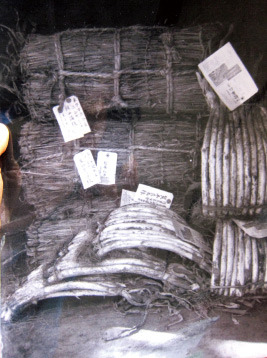
This photograph was taken by mountain photographer Katsuji Yokouchi prior to Showa 10. (Photo courtesy of Hideo Aoki)
This is a rare photograph of “Matsumoto Ippon Negi” (Matsumoto single-stem leeks) packed as a gift; upon closer inspection, the recipient is listed as Heihachirō Tōgō (Admiral and Marshal of the Navy, 1848–1934). The names of Army General Sadao Araki and Asianist Mitsuru Zuyama are also written on the list of recipients. The shipping label reads “Matsumoto Negi.” It is unclear exactly when the term “Matsumoto Ippon Negi” first came into use.

![[First-Time Matsumoto Travel Guide] A Comprehensive Guide to Matsumoto’s Charms: From Stunning Views to Hot Springs and Local Cuisine](/lsc/upfile/article/0000/0028/28_1_m.jpg)

![How to get to Matsumoto: A detailed explanation [JR/bus/plane]](/lsc/upfile/article/0000/0033/33_1_m.jpg)

![[The Gateway to the Alps] The highlights of Matsumoto City’s mountain resorts](/lsc/upfile/article/0000/0024/24_1_m.jpg)